
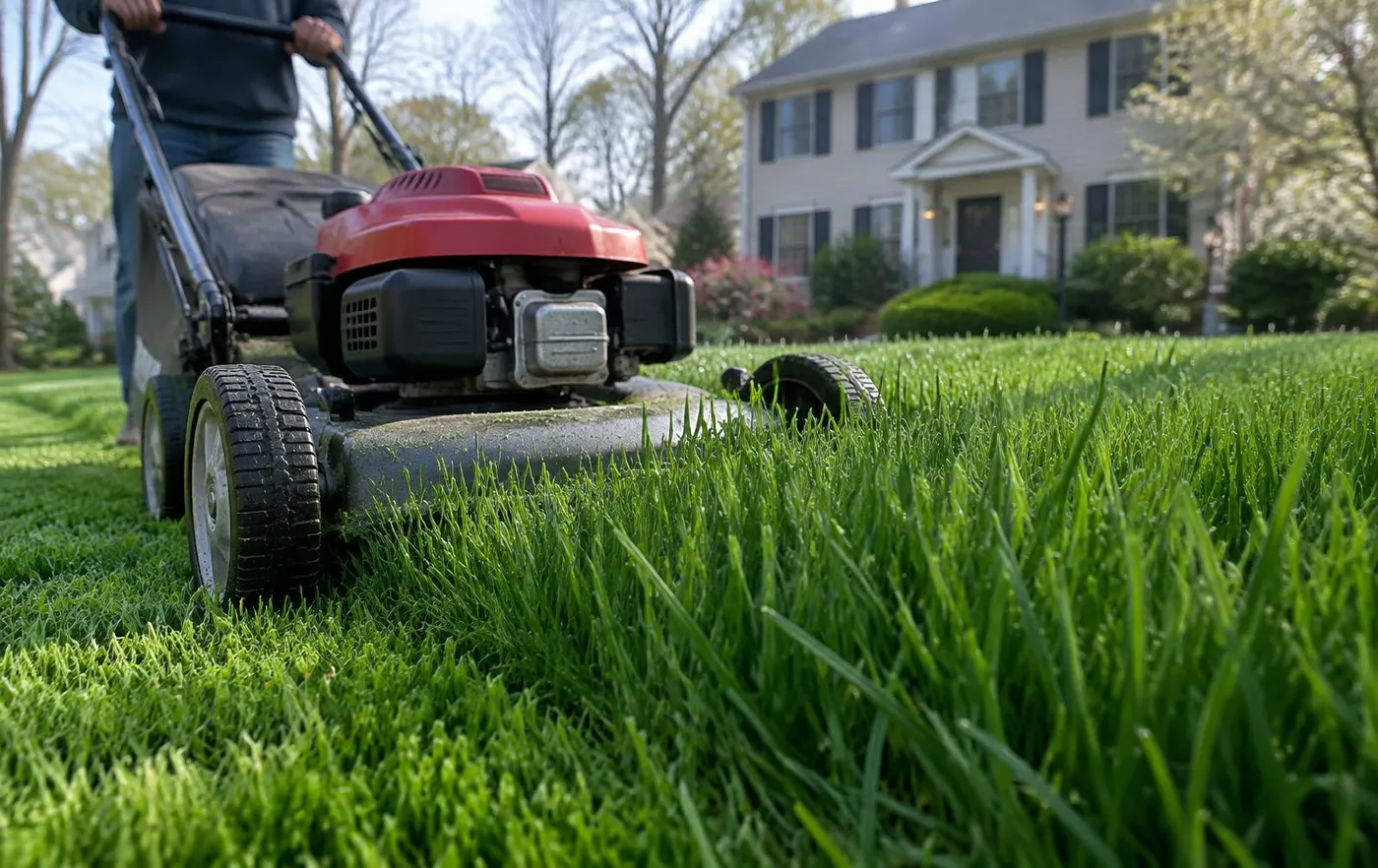
Watering & Mowing
How High Should You Mow Your Lawn in New Jersey?
If there's one lawn-care mistake we see homeowners make over and over again, it's mowing too short. For the tall-fescue lawns common throughout Northern New Jersey, GreenStripe generally prefers a mowing height around 3 to 4 inches—and we typically favor the higher end during summer stress. The tricky part? The number on your mower doesn't necessarily tell you how high you're actually cutting.
GreenStripe Lawn Advice
Reviewed by the GreenStripe Turf Team
Last updated:
On This Page
The Short Answer
For Tall Fescue, Think 3–4 Inches.
GreenStripe generally prefers tall-fescue lawns in Northern New Jersey to be maintained around 3–4 inches. During summer heat and drought stress, we typically prefer mowing toward the higher end of that range. The goal isn't simply a taller-looking lawn. Maintaining adequate leaf tissue helps support photosynthesis, rooting, turf density and greater tolerance of environmental stress.
GreenStripe's preferred tall-fescue heights
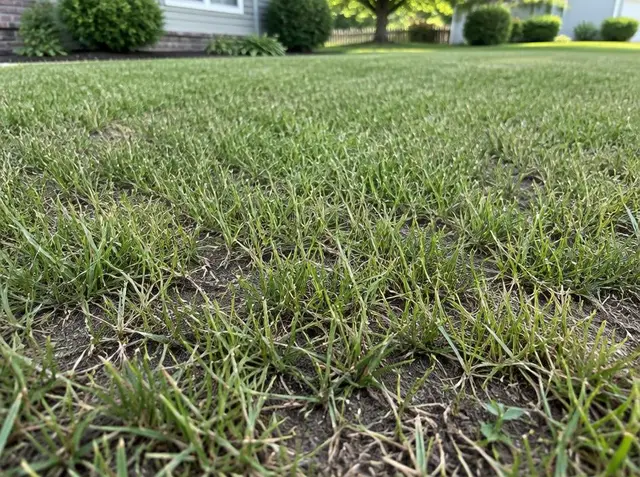
2"
Too short for our preferred tall-fescue management
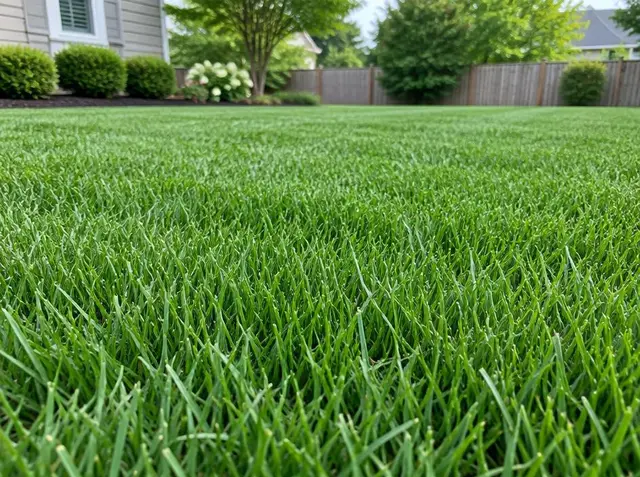
3"
Good target range
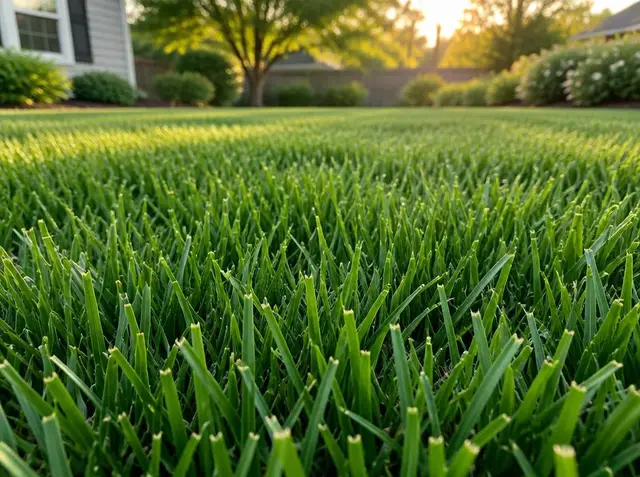
3.5"
GreenStripe sweet spot for many lawns
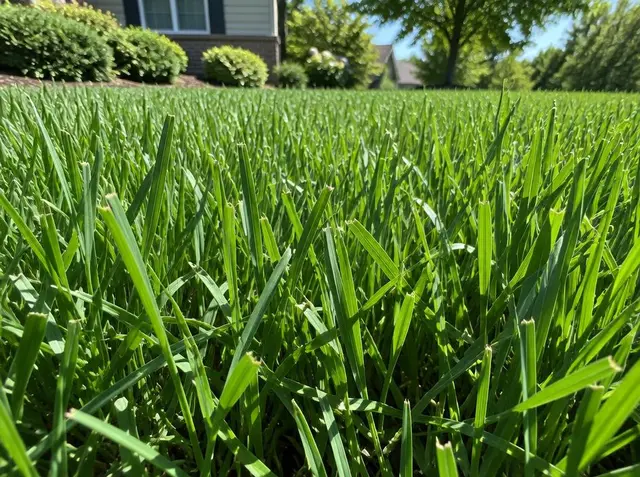
4"
Often preferred during summer stress
The “Middle Setting” Mistake
Most homeowners aren't intentionally scalping their lawn. They simply don't know what their mower settings mean. One mower may have six positions, another seven, eight or nine—and some use an entirely different adjustment system.
Setting #4 does not automatically mean 4 inches. And the middle setting does not automatically mean the correct height for tall fescue. On many mowers, the middle notch is substantially lower than where we want tall fescue.
Don't Know Your Mower Setting? Measure It.
Choose your setting based on the actual height of cut—not where it sits on the lever. Safety comes first: never reach under a mower or measure against the blade.
- Turn the mower completely off.
- Remove the battery or disconnect the spark plug according to the manufacturer's safety instructions before working near the deck or blade.
- Never place hands underneath the mower near a blade unless it has been safely disabled according to its manual.
- Set the mower on a flat surface.
- Check the manufacturer's height-of-cut chart or manual for your exact model.
- Mow a small test area, then use a ruler to measure the actual turf height.
- Adjust until the finished lawn sits approximately within the desired range.
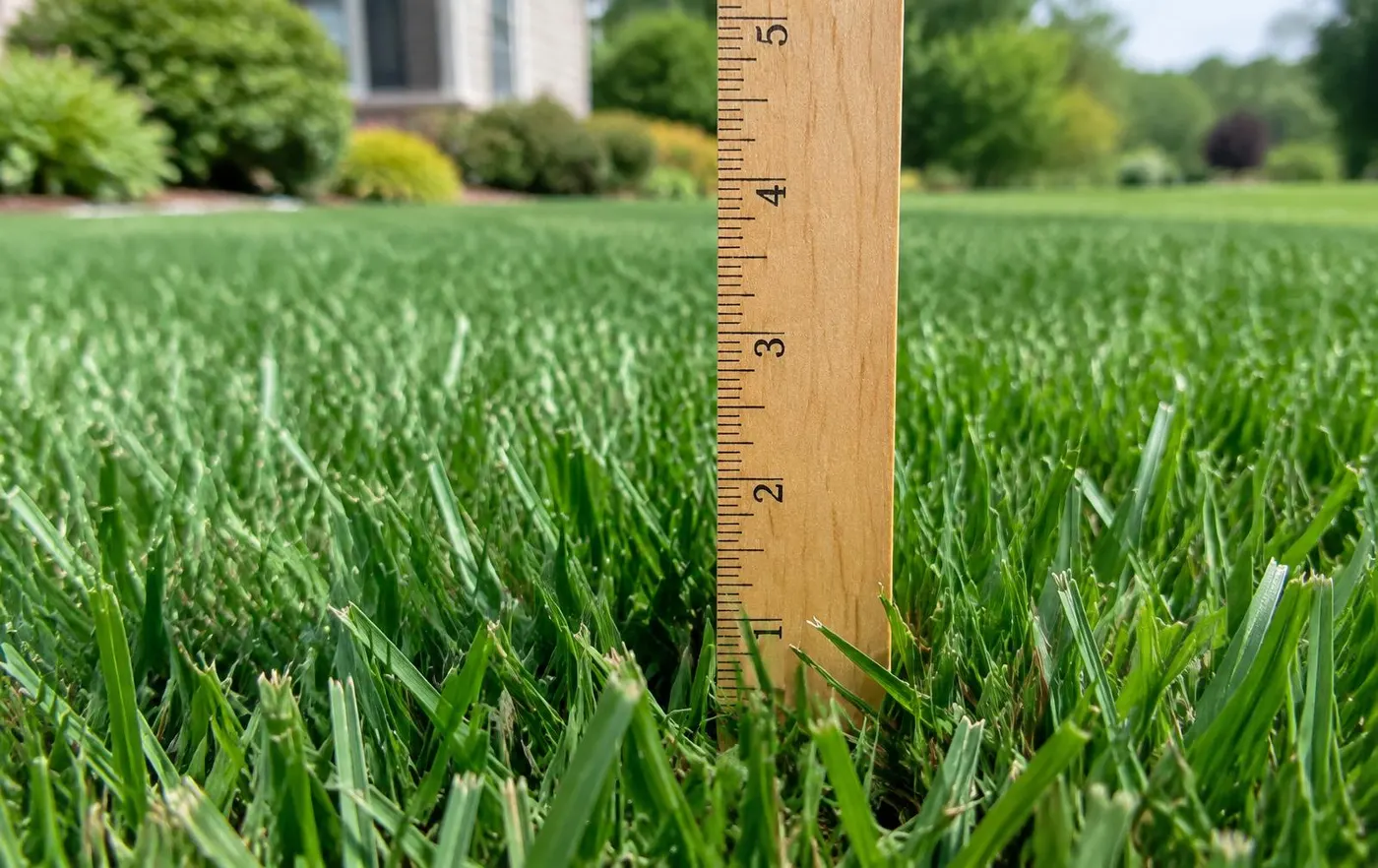
What Setting Should My Mower Be On?
Find Your Mower's Cutting Height
Cutting-height ranges vary by model—even within the same brand—so there's no universal setting for a manufacturer. Use your model's official specifications or manual.
- Check Your EGO Model
EGO
Current EGO residential walk-behind models vary by model. Many offer cutting heights up to approximately 4 inches, while certain models extend higher.
- Check Your Toro Model
Toro
Toro residential mower cutting-height ranges vary by model. Some current residential models adjust up to approximately 4 inches.
- Check Your Honda Model
Honda
Honda HRN residential mowers use seven cutting-height positions from approximately 1 to 4 inches.
Links go to official manufacturer resources for homeowner reference only. GreenStripe has no affiliation with or endorsement from these manufacturers. More brands will be added as model information is verified.
Why We Prefer Taller Tall Fescue
Maintaining more leaf tissue can help support the plant in several ways. Mowing height isn't a cure-all—it won't prevent weeds, crabgrass or disease on its own—but it's one important part of an overall turf-management strategy.
What more leaf tissue helps support
- 1.
Photosynthesis. More healthy leaf area gives the plant greater capacity to produce energy.
- 2.
Rooting + Stress Tolerance. Repeated very-low mowing can weaken turf and reduce its ability to tolerate environmental stress.
- 3.
Shade at the Soil Surface. A denser, taller canopy can reduce the amount of light reaching the soil surface.
- 4.
Turf Density. Appropriate mowing is one part of maintaining a dense stand of desirable turf.
- 5.
Summer Performance. GreenStripe typically raises mowing height during hot weather rather than repeatedly cutting tall fescue short during stress.
Raise the Mower When Spring Growth Takes Off.
As temperatures moderate and tall fescue begins growing aggressively in spring, mowing practices should adjust with it. This is when we commonly see homeowners fall behind: the grass grows quickly, they wait too long, then cut it dramatically shorter to “catch up.” That's exactly what we don't want.
Raise the mower
Don't keep the low height you used during slower growth.
Mow more often
Keep pace with vigorous spring growth.
Remove less
Take less leaf tissue off each time.
Follow the one-third rule.
As a general mowing principle, avoid removing more than approximately one-third of the grass blade in a single mowing. If your target is 3.5 inches, try to mow before the lawn grows well past the point where cutting back would mean removing more than a third.
If the lawn gets unusually tall after a vacation or prolonged rain, don't scalp it back to normal height in one aggressive mowing.
- 1Mow high
- 2Allow recovery
- 3Gradually return toward target height
Summer Is When We Want Tall Fescue Taller.
Summer brings heat, drought stress and additional environmental pressure. This is not when we want homeowners lowering the mower just because the lawn isn't growing as quickly. We generally prefer maintaining tall fescue toward the higher end of our 3–4 inch range during summer. Weather and turf conditions matter—treat this as a guide, not a rigid calendar.
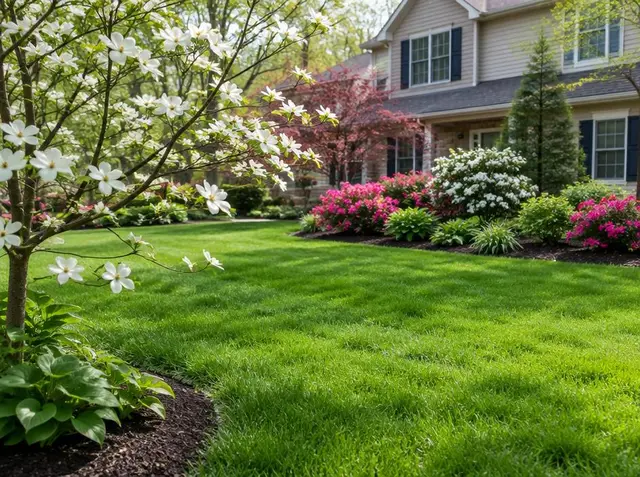
Spring · 3–4"
Raise height as growth accelerates
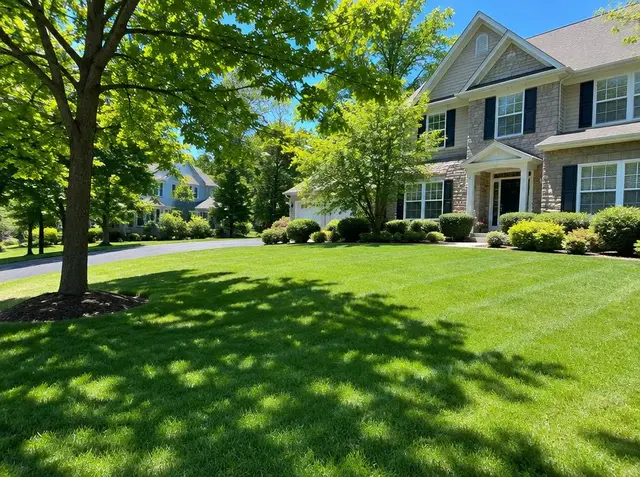
Summer · Toward 4"
Protect leaf area during stress
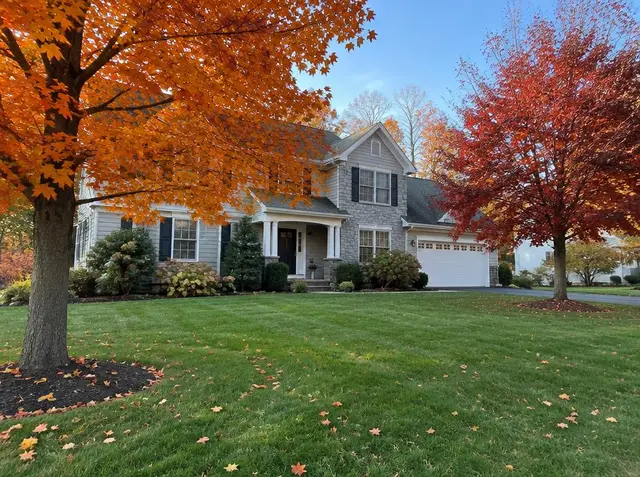
Fall · About 3–4"
Maintain healthy growth as conditions improve
Look at the Cut
Your Mower May Be Causing the Brown Lawn.
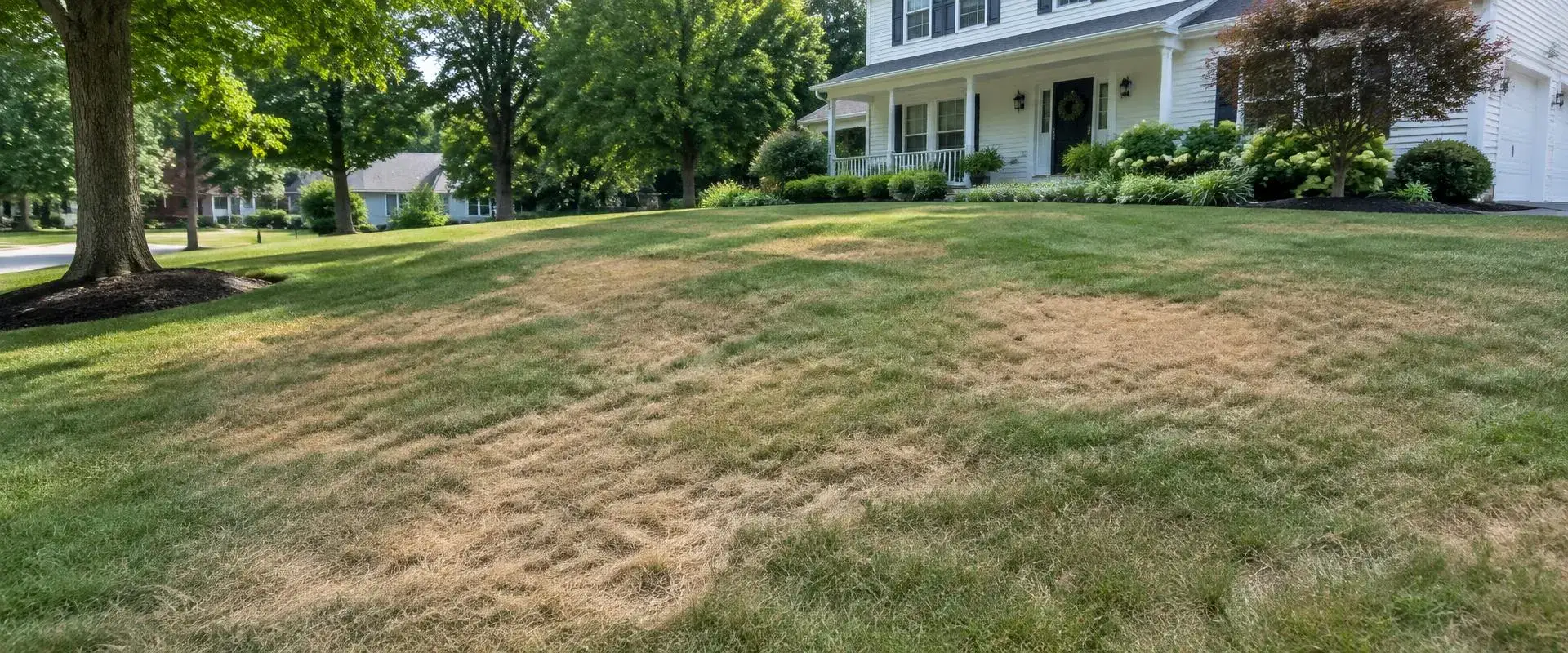
Not every brown lawn needs more fertilizer, more water or a disease treatment. Sometimes the problem is the mower.
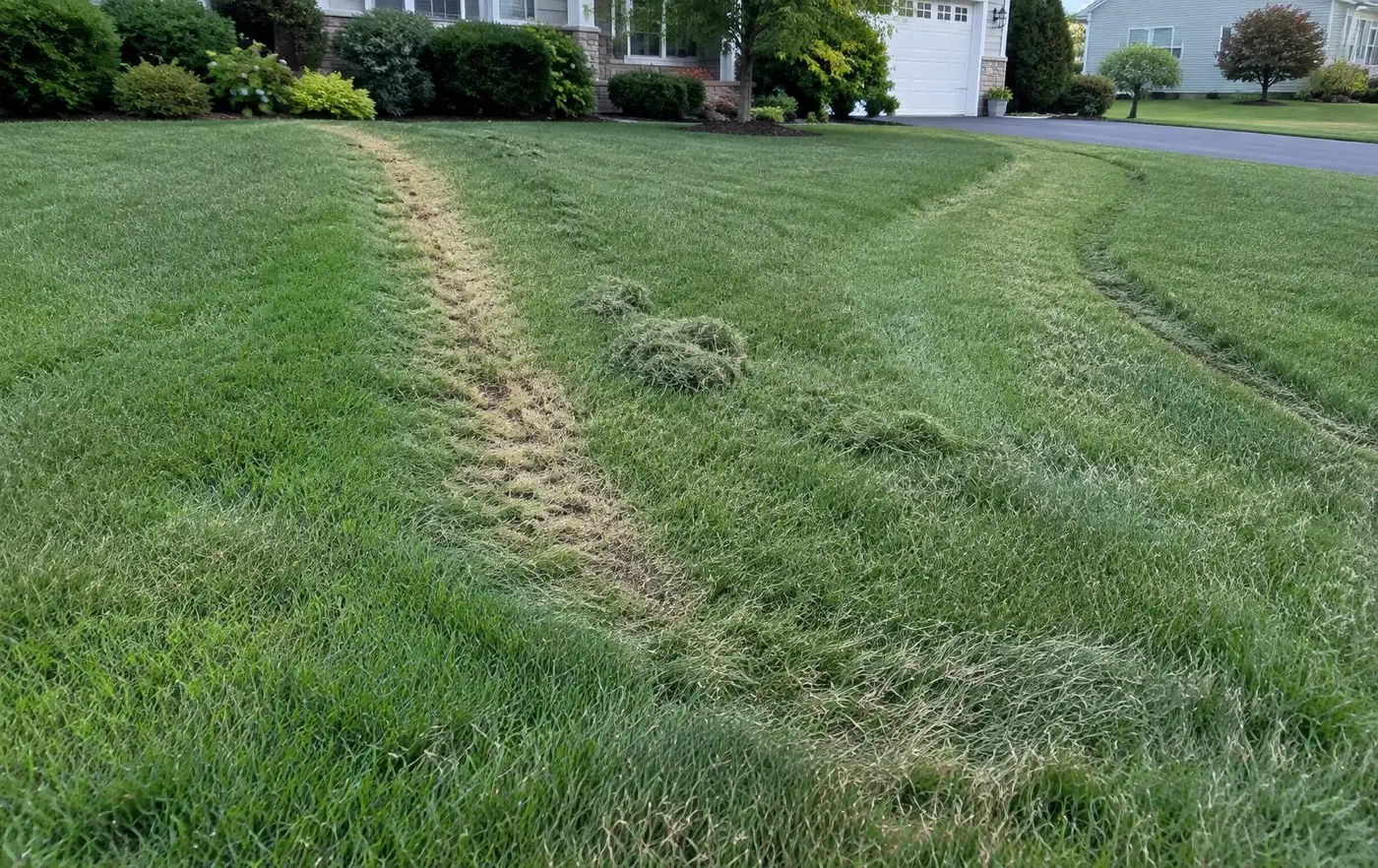
Scalped Area
Cutting height too low or uneven terrain.
Clumping
Wet turf, excessive growth or a mower-performance issue.
Tire / Turn Damage
Aggressive turning or mowing stressed turf.
Uneven Cut
Deck setting, blade condition or a mower issue.
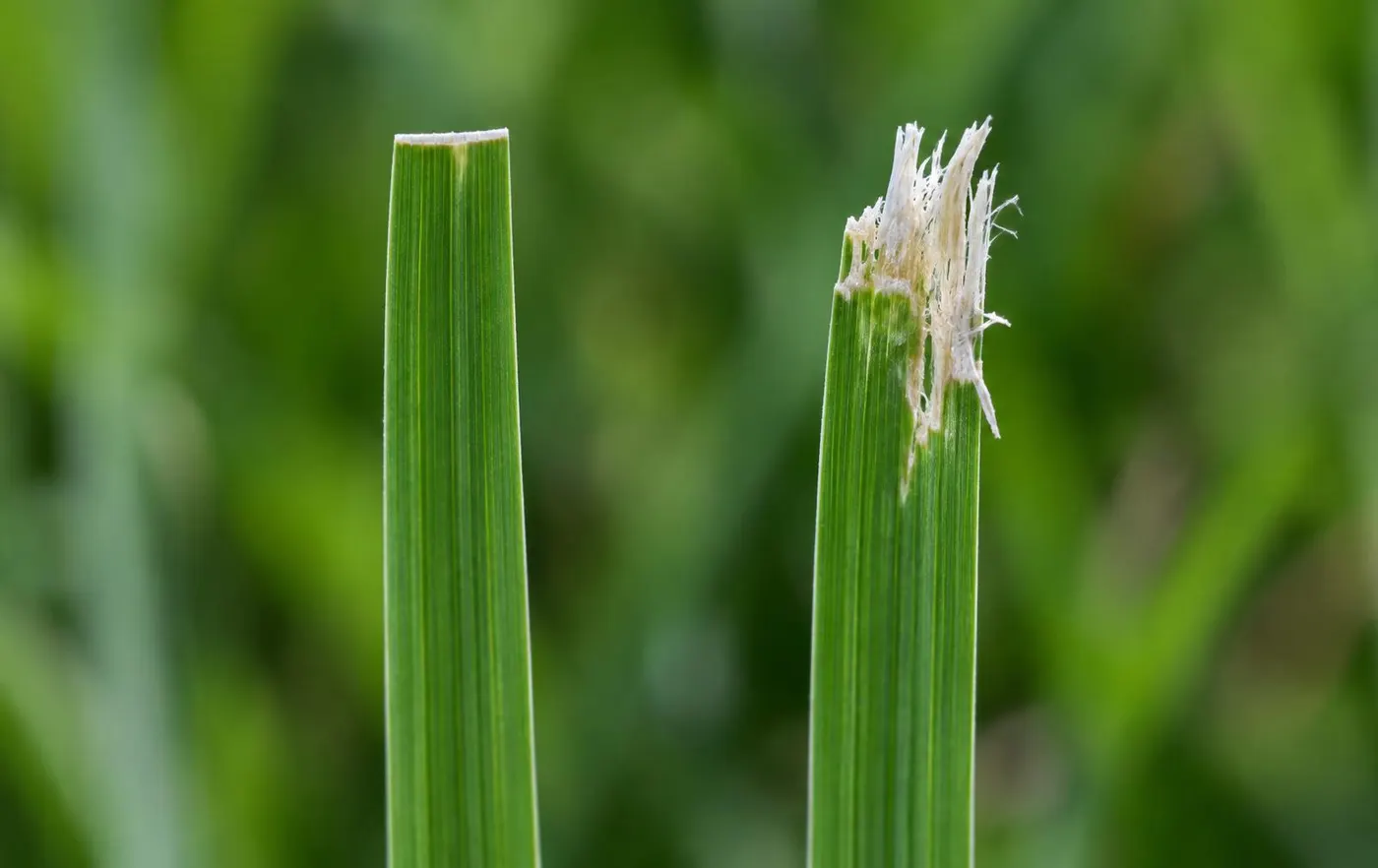
White / Frayed Tips
Possibly a dull mower blade.
A sharp mower blade makes a cleaner cut. A dull blade can tear and shred leaf tissue rather than cutting it cleanly, often leaving grass tips looking frayed, tan, white or brown. From a distance, the lawn may develop a hazy brown cast even though the turf isn't necessarily suffering from drought or disease.
How often should you sharpen a mower blade?
There's no single schedule. It depends on property size, how often you mow, sand and soil exposure, sticks and debris, blade condition and total mowing hours. Someone who mows frequently may need sharpening more often than someone maintaining a small lawn. The best guide is the quality of the cut: if grass tips are consistently torn or frayed after mowing, the blade likely needs attention.
Should You Bag Your Grass Clippings?
Usually, no. When you mow regularly and remove a reasonable amount of growth, returning finely chopped clippings recycles nutrients back into the lawn. Clippings don't normally create thatch simply because they're returned. Bagging can make sense when growth is excessive, clippings are clumping heavily, certain disease or site conditions call for cleanup, or the lawn contains material you don't want redistributed.
Should you mow wet grass?
When practical, wait until the turf is reasonably dry. Wet grass can clump, produce a poorer cut, contribute to rutting on soft soil, make turning damage more likely and spread clippings unevenly. That said, weather doesn't always cooperate—this is a preference, not an absolute rule.
What about newly seeded grass?
Let new turf develop enough height and rooting to tolerate mowing—there's no universal number of days after seeding. When you do mow young grass, wait until conditions are dry enough for mower traffic, use a sharp blade, avoid aggressive turns, don't scalp seedlings and remove only a reasonable amount of leaf tissue. For establishment care, see How to Water New Grass Seed in New Jersey.
GreenStripe Tall Fescue Mowing Guide
The Mowing Standard We Recommend.
Target Height
3–4 inches
Summer
Favor the higher end
Spring Growth
Raise the mower + mow more frequently
One-Third Rule
Avoid removing more than about ⅓ at once
Blade
Keep it sharp
Clippings
Return them when practical
Wet Turf
Let it dry when practical before mowing
Most Common Mistake
Mowing too short
Related Services
Local Lawn Care in Northern New Jersey
Keep Learning
Mowing Questions
How high should I mow tall fescue in New Jersey?
GreenStripe generally prefers tall-fescue lawns in Northern New Jersey to be maintained around 3–4 inches, favoring the higher end during summer.
Why does GreenStripe recommend mowing tall fescue 3–4 inches?
Keeping adequate leaf tissue helps support photosynthesis, rooting, turf density and tolerance of heat and drought stress. Repeated very-low mowing can weaken tall fescue.
Should I mow my lawn higher in summer?
Yes. During summer heat and drought stress, we typically prefer tall fescue toward the higher end of the 3–4 inch range rather than lowering the mower.
What mower setting equals 3.5 or 4 inches?
It depends entirely on your mower model. Setting numbers and the middle notch don't correspond to a specific height. Check your model's height-of-cut chart and measure the finished lawn with a ruler.
Why are my grass tips brown after mowing?
Torn, frayed tips from a dull blade are a common cause. Scalping, mowing stressed turf or removing too much at once can also leave the lawn looking brown.
How can I tell if my mower blade is dull?
Look closely at the grass after mowing. Ragged, shredded or whitish-tan tips—and a hazy brown cast across the lawn—suggest the blade needs attention.
How often should I sharpen my mower blade?
There's no universal schedule. It depends on mowing frequency, lawn size, debris and sand exposure. Let the quality of cut guide you.
Should I bag or mulch grass clippings?
Usually mulch. Returning finely chopped clippings recycles nutrients and doesn't normally cause thatch. Bag when growth is excessive, clippings clump heavily or site conditions warrant cleanup.
Should I mow wet grass?
When practical, wait until the turf is reasonably dry. Wet grass clumps, cuts poorly and makes rutting and turning damage more likely.
What should I do if my lawn gets too tall?
Don't scalp it in one pass. Mow at a high setting, let the lawn recover, then gradually bring it back toward your target height.
Sources & further reading
- Rutgers NJAES — Mowing your lawn: height of cut and mowing frequency for cool-season turf
- Rutgers NJAES — Tall fescue management for New Jersey home lawns
- Rutgers NJAES — Grass clippings: return them to the lawn
- Manufacturer owner's manuals and cutting-height specifications for the specific mower models referenced